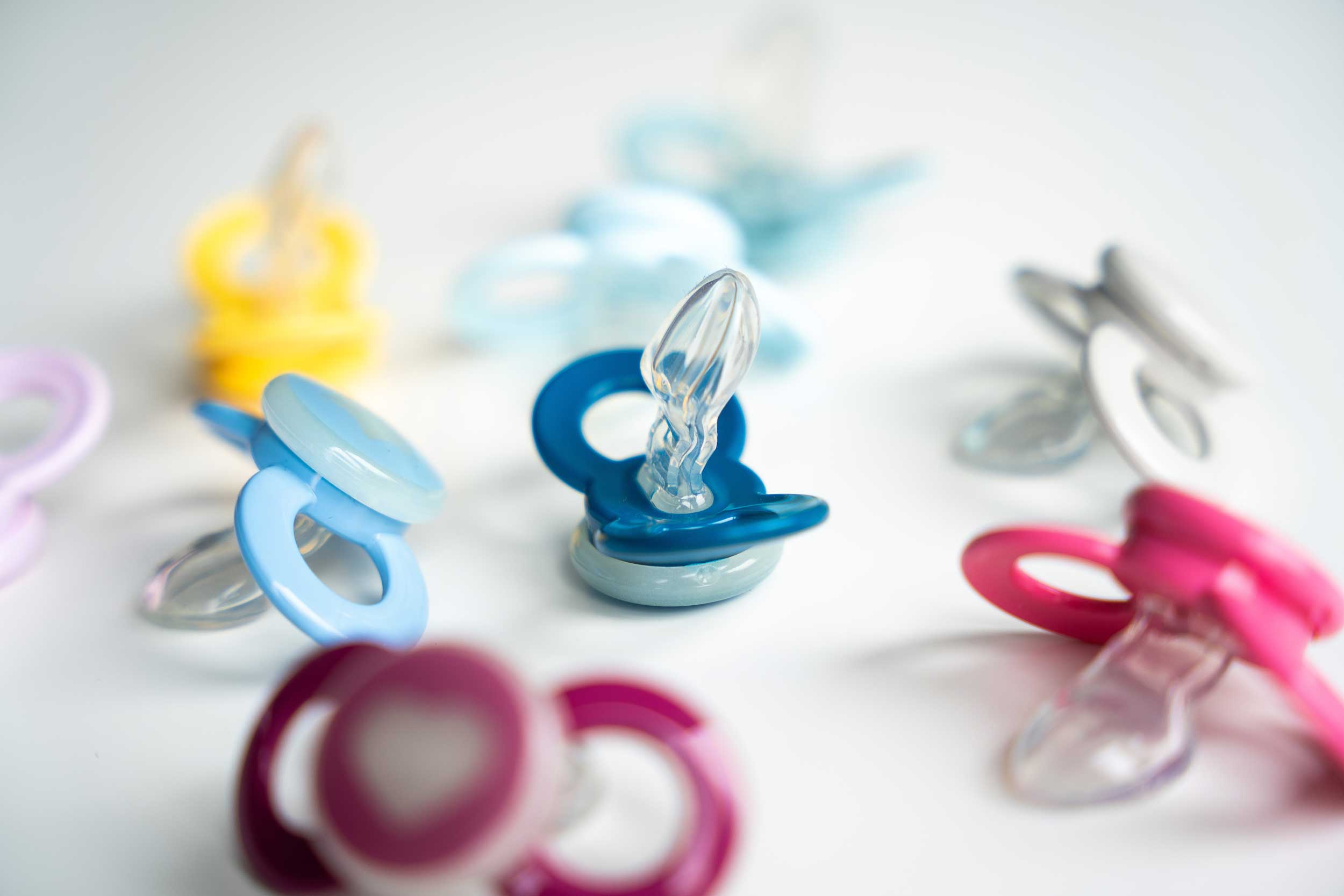
Pacifiers, teething rings, and other baby products come into daily contact with babies’ mouths. It’s understandable, then, that parents pay particularly close attention to the materials these products are made of and what substances they might contain.
One question we hear time and again is: Are dentistar products BPA-free?
The answer is clear: Yes, the materials we use are BPA-free.
But what exactly is BPA? Why was this substance previously used in products commonly found in babies’ daily lives? And why is the “BPA-free” label increasingly disappearing from packaging today?
What is BPA?
BPA is the abbreviation for bisphenol A. It is an industrial chemical that has been used for many years in the production of certain plastics and synthetic resins, among other things.
BPA is particularly well known as a raw material for polycarbonate. This plastic is hard, transparent, chemical-resistant, and exceptionally shatter-resistant. For a long time, these properties also made it an attractive choice for drinking vessels, containers, and other everyday products. BPA was also used in the production of certain epoxy resins, such as those used for the interior coatings of food packaging. It is precisely these practical material properties that explain why BPA was previously used in products that came into contact with food and beverages.
Why is BPA a problem today?
As research has progressed, the assessment of BPA has changed. The substance can be released in small amounts from certain materials, enter food, and thus be absorbed by the human body.
BPA is viewed with particular concern due to its potential health effects. The European Food Safety Authority (EFSA) has significantly tightened its risk assessment in recent years, focusing in particular on potential effects on the immune system. As a result, the European Commission has largely banned the use of BPA in food contact materials. Strict bans on BPA in baby bottles and certain drinking vessels for infants and toddlers were already in place under EU Regulation No. 321/2011.
It is especially important to handle potentially problematic materials with great care, particularly when it comes to babies and toddlers. Children are still in the midst of their development, and pacifiers, teats, and sippy cups are sometimes used for many hours a day.
Why was BPA so important in the past?
The label “BPA-free” has a historical background when it comes to baby products.
In the past, polycarbonate was frequently used in baby bottles and as a key component in various baby products. BPA is used in the production of this plastic.
As BPA came under increasing scrutiny, many manufacturers switched to other materials. Polypropylene, or PP for short, became particularly widespread. BPA is not required for the production of polypropylene.
For parents, however, this change in material was difficult to recognize based on designations such as “PC” or “PP.” The clearly visible “BPA-free” label therefore provided a simple guide and made it clear that no BPA was used as a raw material in the product in question.
The labeling has become established over many years. In the meantime, however, both the materials used and the legal requirements have evolved.
Why are we discontinuing the “BPA-free” label in the future?
Today, depending on the product, we use materials such as polypropylene, silicone, and other suitable materials in our pacifiers, teething rings, toys, and baby bottles. The materials we use are BPA-free.
At the same time, the legal requirements regarding BPA in the European Union have been significantly tightened. The use of BPA in materials that come into contact with food is now generally prohibited. Transitional provisions and a few exceptions still apply for certain applications.
The label “BPA-free” therefore has a different meaning today than it did back when polycarbonate containing BPA was still much more common in baby products.
For this reason, we will no longer highlight “BPA-free” as a specific feature on our packaging or in our product descriptions. This does not change the materials we use.
Instead, we want to provide you with transparent information about the materials we use and the safety requirements that apply to each product.
Safety at dentistar
When selecting our materials, we take into account the requirements of the respective product group. This isn’t just about BPA—it’s about the safety of the entire product.
Our pacifiers, for example, are evaluated according to the requirements of DIN EN 1400. This standard defines specific safety requirements and testing procedures for pacifiers. For related feeding accessories, the requirements of DIN EN 14350 apply.
After all, the safety of a baby product does not depend on a single note on the packaging. What matters most are suitable materials, a safe design, the necessary tests, and compliance with applicable requirements.
What should parents look for when buying baby products?
A label such as “BPA-free” can be helpful information. However, it’s not the only feature you should look for when making a purchase.
Here’s what parents should keep in mind
- Who is the manufacturer?
Important information regarding identification and traceability should be provided on the product or its packaging. This includes, for example, details about the manufacturer and contact information. - Are there clear safety instructions?
If specific instructions or warnings are required for the safe use of a product, they should be clearly stated. It’s therefore worth taking a look at the packaging and the included product information. - Is it clear who is responsible for the product?
It’s especially worth taking a closer look at products from unknown online stores. Can you tell where the product comes from and who to contact if you have questions?
What does that mean for you?
Parents already have enough things to worry about in their daily lives. BPA in dentistar products isn’t one of them.
dentistar remains BPA-free
We comply with the European requirements and safety standards that apply to our product categories. At the same time, we make it clear that all of our products are BPA-free. This allows you to focus more on what really matters: all the little and big moments with your baby.
The materials we use are BPA-free. We simply choose not to include additional labeling and instead provide transparent information about materials and product safety.
References
EFSA, Europäische Behörde für Lebensmittelsicherheit: Re evaluation of Bisphenol A (BPA), wissenschaftliche Bewertung von BPA und Neubewertung der tolerierbaren täglichen Aufnahmemenge.
Verordnung (EU) Nr. 321/2011: Regelungen zur Verwendung von Bisphenol A in Säuglingsflaschen aus Polycarbonat.
Verordnung (EU) 2024/3190: Regelungen der Europäischen Kommission zu Bisphenol A und anderen Bisphenolen in bestimmten Lebensmittelkontaktmaterialien.
Verordnung (EU) 2023/988, GPSR: Allgemeine Produktsicherheitsverordnung mit Anforderungen unter anderem an Herstellerinformationen, Rückverfolgbarkeit und verantwortliche Wirtschaftsakteure.
DIN EN 1400: Sicherheitsanforderungen und Prüfverfahren für Schnuller für Säuglinge und Kleinkinder.
DIN EN 14350: Sicherheitsanforderungen und Prüfverfahren für Artikel für flüssige Kindernahrung.